Source High Visibility Kids Safety Vest for Road Safety, Traffic Control, and School Events
Find 30 high visibility kids safety vest options with features like waterproofing and breathable fabric. Buyers can compare models with customized sizes, LED flash capabilities, and various color choices from verified Chinese manufacturers.
Key considerations
Products List


Comprehensive Sourcing Guide
Strategic Sourcing Guide for High Visibility Kids Safety Vests
Procuring high visibility children's safety vests requires a nuanced understanding of the intersection between child safety standards, material durability, and supply chain logistics. Unlike adult safety gear, children's vests must balance strict visibility requirements with comfort, fit, and the specific behavioral patterns of younger users. This guide synthesizes available market data to help buyers navigate the selection process, focusing on verified attributes, compliance verification, and cost management strategies without relying on unverified supplier claims.
Understanding Core Product Specifications and Variations
The foundation of a successful procurement strategy lies in accurately defining the technical specifications required for the specific use case. Market data indicates a diverse range of product attributes available for high visibility children's safety vests. A critical observation is the variation in target age groups; while some listings explicitly categorize products for "Adults," others specify "Children," necessitating a rigorous filter during the initial search phase to ensure the product matches the intended demographic.
Material composition is another primary differentiator. The supply chain offers vests constructed from "100% Polyester Mesh" as well as general "Polyester" blends. The mesh variant is often preferred for its breathability, a feature explicitly listed in several product profiles. This is particularly relevant for summer usage, where ventilation is essential to prevent overheating during outdoor activities. Conversely, some products highlight "water proof" capabilities, suggesting a coated or laminated finish that may trade off some breathability for weather resistance. Buyers must weigh these trade-offs based on the environmental conditions where the vests will be deployed.
Size and fit are paramount for children's safety gear. Specifications range from standardized sizing (S, M, L) to fully "Customized Size" options. The latter is often necessary for bulk orders targeting specific age ranges or for custom branding projects. Additionally, the physical dimensions of the vest, such as "Medium Long" length and "Medium" thickness, influence the coverage area and the amount of reflective material applied. The presence of "Pockets" is a notable feature in certain models, adding utility for storing small items, though this must be balanced against the risk of children getting caught on objects.
Compliance Verification and Certification Standards
Safety is the non-negotiable pillar of high visibility apparel. When sourcing for children, buyers must verify that products meet recognized international standards for visibility and safety. While specific market listings mention certifications such as "ISO" and "CE En20471," these should be treated as claims requiring independent verification rather than guaranteed attributes of every listed item. The standard EN20471 is widely recognized for high-visibility clothing, but its applicability to children's specific sizes and materials must be confirmed with the supplier.
Buyers should also be aware of other potential standards like EN1150, which is often associated with children's clothing safety, though its direct application to high-visibility reflective gear may vary by region. It is crucial to understand that "Low-confidence background" standards should not be cited as definitive compliance without proof. Instead of accepting a supplier's assertion that a vest is compliant, procurement teams should request valid test reports from accredited laboratories. These reports should explicitly state the standard number, the test date, and the specific product model tested.
Furthermore, the "Customized" nature of many safety vests introduces complexity regarding certification. If a buyer requests a custom logo or modified design, the original certification may no longer apply to the modified product. In such cases, the supplier must confirm whether the customization affects the reflective area or material properties in a way that invalidates the original safety rating. Buyers should insist on a clear statement regarding how customization impacts compliance status before placing an order.
Cost Drivers and Economic Considerations
The pricing landscape for high visibility children's safety vests is influenced by several dynamic factors. Observed market data suggests a price range of $0.33 to $7.50 USD, a significant spread that reflects differences in material quality, feature sets, and order volumes. The lower end of this spectrum typically corresponds to basic polyester vests with standard reflective strips, while the higher end often includes advanced features like "LED Flash" technology, enhanced waterproofing, or specialized mesh fabrics.
Minimum Order Quantity (MOQ) is a critical cost driver. The market shows a wide range, from as low as 20 pieces to as high as 5,000 pieces, with a common baseline of 1,000 pieces for many suppliers. For buyers with smaller budget constraints or those testing a new product line, finding suppliers with lower MOQs (e.g., 20-100 pieces) can be advantageous, though the unit cost will likely be higher. Conversely, larger orders can leverage economies of scale to reduce the per-unit price significantly.
Customization services, such as "Customized Logo," "OEM," and "ODM" support, add to the overall cost. These services often involve setup fees or higher per-unit charges due to the additional labor and material handling required. Buyers should also consider packaging costs, as specifications vary from simple "1PC/Polybag" to bulk "Carton" packing with specific dimensions like "482545" or "653540." The weight of the carton, noted as "22kg" in some listings, impacts shipping costs, which can be a substantial portion of the total landed cost for international buyers.
Typical Applications and Functional Requirements
The intended application of the vest dictates the necessary features and durability standards. Market data highlights several key usage scenarios, including "Road Safety," "Workplace Safety," "Traffic Warden," "Security Staff," and "Sanitation Workers." For children, the primary application is often pedestrian safety, ensuring visibility to drivers during school commutes or outdoor play. In these scenarios, "Hi visibility" and "Glistening" features are essential to catch the light of vehicle headlights.
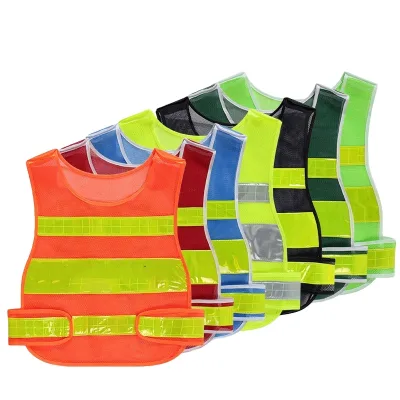
Some products are designed for specific professional roles, such as "Traffic Warden" or "Security Staff," which may require additional durability or specific color combinations like "Green, Red, Navy, Orange, Dark Red, Light Blue." The "Self-Protective" feature mentioned in some listings suggests designs that offer enhanced protection against environmental hazards, though the exact nature of this protection should be clarified. For summer events or outdoor activities, the "Breathable" and "Function" attributes become critical to ensure the child remains comfortable while wearing the vest for extended periods.
The inclusion of "LED Flash" technology represents a specialized application where active illumination is required, such as for night-time events or low-light conditions. This feature significantly increases the unit cost and may require battery management considerations. Buyers must determine if the target audience requires passive reflection only or active lighting. Additionally, the "Water proof" attribute is vital for applications involving rain or wet environments, ensuring the reflective material remains effective even when the fabric is damp.
Supplier Evaluation and Geographic Sourcing
Evaluating suppliers requires a careful review of their origin and production capabilities. The supply chain for these products is concentrated in specific regions of China, with "Shandong," "Zhejiang," and "Jiangsu" appearing as common places of origin. Each region may have different specializations; for instance, Zhejiang is known for its textile industry, while Shandong may have a strong focus on safety equipment manufacturing. Buyers should verify the specific factory location to ensure it aligns with their logistical preferences and quality expectations.
When assessing suppliers, the consistency of product attributes is a key indicator of reliability. Discrepancies in model numbers (e.g., MD252, MD250, MD240, MD224, MD227, rc-Vest, VEST240) suggest a diverse product line, but buyers must ensure the specific model ordered matches the requested specifications exactly. The "prod_packing" details, such as carton dimensions and quantity per carton, should be consistent across the order to facilitate efficient warehousing and shipping.
Buyers should also scrutinize the "Customized Support" capabilities. Suppliers offering "Customized Logo," "OEM," and "ODM" services demonstrate flexibility, but the quality of these services varies. It is essential to request samples of previous customization work to verify the print quality and durability of the logos. Additionally, the "Standard" of the product, often listed as "customized," implies that the supplier may not adhere to a rigid set of internal standards, making the verification of their quality control processes even more critical.
Quality Control and Long-Term Procurement Strategy
Implementing a robust quality control (QC) protocol is essential for maintaining the safety and reputation of the brand. Given the critical nature of safety vests, buyers should establish clear acceptance criteria for reflective material brightness, seam strength, and colorfastness. The "Medium" thickness and "Medium Long" length specifications should be verified against physical samples to ensure they meet the intended coverage requirements. Any deviation in these dimensions could compromise the safety performance of the vest.
For long-term procurement, building a relationship with a reliable supplier is more valuable than chasing the lowest price. Suppliers with a history of providing "ISO" and "CE" certified products are preferable, but this certification must be current and applicable to the specific product model. Buyers should also consider the lead time and production capacity, especially when dealing with custom orders that may require additional time for logo application or material sourcing.
Sustainability and durability are emerging considerations in the procurement of safety gear. While the current data emphasizes features like "Breathable Fabric" and "Water proof," buyers should inquire about the recyclability of the "100% Polyester Mesh" and the environmental impact of the manufacturing process. Long-term contracts should include clauses for quality assurance, allowing for regular audits and re-testing of products to ensure they continue to meet safety standards over time.
Comparison of Key Product Attributes
To facilitate decision-making, the following table summarizes the key variations observed in the market for high visibility children's safety vests. This comparison highlights the trade-offs buyers must consider when selecting a product.
| Attribute Category | Option A: Basic Mesh Vest | Option B: Waterproof/LED Vest | Option C: Customized OEM Vest |
|---|---|---|---|
| Primary Material | 100% Polyester Mesh | Polyester (Coated) | Polyester (Customizable) |
| Key Features | Breathable, Hi Visibility | Water Proof, LED Flash | Custom Logo, OEM/ODM |
| Target Age | Children / Adults | Children / Adults | Children / Adults |
| Certification | Variable (Verify ISO/CE) | Variable (Verify ISO/CE) | Variable (Verify ISO/CE) |
| MOQ Range | 100 - 5000 pcs | 20 - 5000 pcs | 1000 pcs (Typical) |
| Price Range | $0.33 - $3.00 USD | $3.00 - $7.50 USD | $1.50 - $6.00 USD |
| Packing | 1PC/Polybag | 482545 / 100PCS/Ctn | 653540 / Custom |
| Best For | Summer, High Breathability | Rain, Night Safety | Branding, Specific Sizes |
In conclusion, sourcing high visibility children's safety vests requires a meticulous approach that prioritizes safety compliance, material suitability, and supplier reliability. By carefully analyzing the technical specifications, verifying certifications, and understanding the cost drivers, buyers can make informed decisions that ensure the safety and well-being of children while maintaining cost efficiency. The diversity of options in the market allows for tailored solutions, but the burden of verification remains with the buyer to ensure that every vest meets the highest standards of safety and quality.
FAQs
What materials are used for high visibility kids safety vests?
These vests are typically constructed from 100% Polyester Mesh or general Polyester blends. The mesh variant offers superior breathability for summer use, while other options may provide water-proof capabilities for wet weather conditions.
Can I customize the logo on these safety vests?
Yes, customized logo acceptance is available along with OEM and ODM support. Buyers can request specific branding, though they must verify that such modifications do not invalidate existing safety certifications like ISO or CE En20471.
Which certifications apply to high visibility kids safety vests?
Some products list ISO and CE En20471 certifications as standard compliance markers. Buyers should request valid test reports to confirm these standards apply to the specific model and size, especially when custom designs are involved.
How does the minimum order quantity affect pricing?
Minimum order quantities range from 20 pieces to 5000 pieces, with 1000 pieces being a common baseline. Lower MOQs often result in higher unit costs, while larger orders leverage economies of scale to reduce the price per vest.
What sizes are available for children's safety vests?
Vests come in standardized sizes like S, M, and L or fully customized dimensions. Customized sizing is often necessary for bulk orders targeting specific age groups or for ensuring a precise fit for different child demographics.
Where are these vests typically manufactured?
Production origins include Shandong, Zhejiang, and Jiangsu provinces in China. Each region has different specializations, so buyers should verify the specific factory location to align with logistical preferences and quality expectations.
Are there features like pockets or LED lights available?
Certain models include pockets for utility and LED flash technology for active illumination. These advanced features increase the unit cost and may require battery management, making them suitable for specific night-time or low-light applications.